
BraAndKet is a library for numeral calculations of discrete quantum systems.

Project description
BraAndKet

BraAndKet is a library for numeral calculations of discrete quantum systems.
Quickstart
Before Using
Please notice that this library is still actively developing. The stability and compatibility of APIs are NOT guaranteed. Breaking changes are happening every day! Using this library right now, you may take your own risk.
Installation
You can install the latest release from PiPy.
pip install braandket
Then you can import this library with name bnk
import braandket as bnk
KetSpace
Any quantum states can exist in some space called Hilbert space. You can use bnk.KetSpace(n) to define such a space,
where n is its dimension. For example, to create a Hilbert space of a q-bit:
qbit = bnk.KetSpace(2)
print(qbit)  # output: KetSpace(2)
You can define a name for a space using named parameter. The name is to describe this space when debugging. The name can
be a str, or any object to be printed out. When printed, the name of space will be shown, which is very helpful when
debugging.
qbit_a = bnk.KetSpace(2, name="a")
print(qbit_a)  # output: KetSpace(2, name=a)

qbit_b = bnk.KetSpace(2, name="b")
print(qbit_b)  # output: KetSpace(2, name=b)
You can call these 4 methods on a KetSpace instance to create ket vectors and operators:
- method
.eigenstate(k)- to get a ket vector, representing the k-th eigenstate - method
.identity()- to get an identity operatorin this Hilbert space
- method
.operator(k,b)- to get an operator - method
.projector(k)- to get a projector


ket_space = bnk.KetSpace(2)

ket_vec = ket_space.eigenstate(0)
identity_op = ket_space.identity()
increase_op = ket_space.operator(1, 0)
zero_proj = ket_space.projector(0)
A KetSpace is accompanied by a BraSpace. You can conveniently get it with .ct property. To avoid confusion, is not
allowed to create any vectors or operations with a BraSpace. Please do so with its corresponding KetSpace.
Calling .ct property, you can get back its KetSpace.
ket_space = bnk.KetSpace(2)
print(ket_space)  # output: KetSpace(2)

bra_space = ket_space.ct
print(bra_space)  # output: BraSpace(2)

print(bra_space.ct is ket_space)  # output: True
QTensors
QTensor is the basic type of computing elements in this library. A QTensor instance holds an np.ndarray as its
values and a tuple of Space instances. Each Space corresponds to an axis of the np.ndarray.
Any vectors, operators and tensors in quantum world are represented by QTensor. All vectors and operators mentioned
above are all QTensor instances.
ket_space = bnk.KetSpace(2)

ket_vec = ket_space.eigenstate(0)
print(ket_vec)
# output: QTensor(spaces=(KetSpace(2),), values=[1. 0.])

identity_op = ket_space.identity()
print(identity_op)
# output: QTensor(spaces=(KetSpace(2), BraSpace(2)), values=[[1. 0.] [0. 1.]])

increase_op = ket_space.operator(1, 0)
print(increase_op)
# output: QTensor(spaces=(KetSpace(2), BraSpace(2)), values=[[0. 0.] [1. 0.]])

zero_proj = ket_space.projector(0)
print(zero_proj)
# output: QTensor(spaces=(KetSpace(2), BraSpace(2)), values=[[1. 0.] [0. 0.]])
You can easily get a conjugate transposed QTensor calling .ct property. It should be noted that sometimes, such
operation does not affect the values, but spaces.
ket_space = bnk.KetSpace(2)

ket_vec = ket_space.eigenstate(0)
bra_vec = ket_vec.ct
print(bra_vec)
# output: QTensor(spaces=(BraSpace(2),), values=[1. 0.])

increase_op = ket_space.operator(1, 0)
decrease_op = increase_op.ct
print(decrease_op)
# output: QTensor(spaces=(BraSpace(2), KetSpace(2)), values=[[0. 0.] [1. 0.]])
QTensor instances can take tensor product using @ operator. They can automatically inspect which spaces to be
performed the "product-sum" (when the bra on the left meets the matching ket on the right), which to be remained.
Example1:

qbit = bnk.KetSpace(2)

amp = qbit.eigenstate(0).ct @ qbit.eigenstate(1)
print(amp)
# output: QTensor(spaces=(), values=0.0)
Example2:

qbit_a = bnk.KetSpace(2, name="a")
qbit_b = bnk.KetSpace(2, name="b")

ket_vec_ab = qbit_a.eigenstate(0) @ qbit_b.eigenstate(1)
print(ket_vec_ab)
# output: QTensor(spaces=(KetSpace(2, name=a), KetSpace(2, name=b)), values=[[0. 1.] [0. 0.]])
Example3:

qbit_a = bnk.KetSpace(2, name="a")
qbit_b = bnk.KetSpace(2, name="b")

tensor_ab = qbit_a.eigenstate(0).ct @ qbit_b.eigenstate(1)
print(tensor_ab)
# output: QTensor(spaces=(BraSpace(2, name=a), KetSpace(2, name=b)), values=[[0. 1.] [0. 0.]])
Example4:
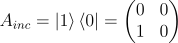

qbit = bnk.KetSpace(2)

ket_vec_0 = qbit.eigenstate(0)
ket_vec_1 = qbit.eigenstate(1)
increase_op = qbit.operator(1, 0)
result = increase_op @ ket_vec_0

print(result)
# output: QTensor(spaces=(KetSpace(2),), values=[0. 1.])

print(result == ket_vec_1)
# output: True
Contribution
This library is completely open source. Any contributions are welcomed. You can fork this repository, make some useful changes and then send a pull request to me on GitHub.
Release history Release notifications | RSS feed


Download files
Download the file for your platform. If you're not sure which to choose, learn more about installing packages.
Source Distribution
Built Distribution
Filter files by name, interpreter, ABI, and platform.
If you're not sure about the file name format, learn more about wheel file names.
Copy a direct link to the current filters
File details
Details for the file BraAndKet-0.8.5.tar.gz.
File metadata
- Download URL: BraAndKet-0.8.5.tar.gz
- Upload date:
- Size: 14.5 kB
- Tags: Source
- Uploaded using Trusted Publishing? No
- Uploaded via: twine/4.0.2 CPython/3.11.4
File hashes
| Algorithm | Hash digest | |
|---|---|---|
| SHA256 |
cbca4469661ff7f7eba024231435e7798f5503766fc61fc6efb0f0b6117e9df5
|
|
| MD5 |
b32395a249706d3819a756a97d0ca49d
|
|
| BLAKE2b-256 |
20ca29d70281cdd4192a05591e587b77419dbd909436621cd48a02b47fe3621e
|
File details
Details for the file BraAndKet-0.8.5-py3-none-any.whl.
File metadata
- Download URL: BraAndKet-0.8.5-py3-none-any.whl
- Upload date:
- Size: 19.8 kB
- Tags: Python 3
- Uploaded using Trusted Publishing? No
- Uploaded via: twine/4.0.2 CPython/3.11.4
File hashes
| Algorithm | Hash digest | |
|---|---|---|
| SHA256 |
9aaee35e17fc586221145a76ba362d3b7c951ef0309e17a8262210b3ea6afb4d
|
|
| MD5 |
4215fe529476807742b85de963c144fc
|
|
| BLAKE2b-256 |
6f79829bd9143d6592acacca077179cf733b2550db9b97feb1b9837e1a6d7607
|






