
CMA-ES, Covariance Matrix Adaptation Evolution Strategy for non-linear numerical optimization in Python

Project description
A stochastic numerical optimization algorithm for difficult (non-convex, ill-conditioned, multi-modal, rugged, noisy) optimization problems in continuous search spaces, implemented in Python.
Typical domain of application are bound-constrained or unconstrained objective functions with:
search space dimension between, say, 5 and (a few) 100,
no gradients available,
at least, say, 100 times dimension function evaluations needed to get satisfactory solutions,
non-separable, ill-conditioned, or rugged/multi-modal landscapes.
The CMA-ES is quite reliable, however for small budgets (fewer function evaluations than, say, 100 times dimension) or in very small dimensions better (i.e. faster) methods are available.
The pycma module provides two independent implementations of the CMA-ES algorithm in the classes cma.CMAEvolutionStrategy and cma.purecma.CMAES.
Installation
There are several ways of installation:
In the terminal command line type:
python -m pip install cma
Typing just pip instead of python -m pip may be sufficient. Or, alternatively:
easy_install cma
The package will be downloaded and installed automatically. To upgrade an existing installation, ‘cma’ must be replaced by ‘-U cma’ in both cases. If you never heard of pip, see here.
Download and unpack the cma-...tar.gz file and type:
pip install -e cma
or:
python setup.py install
in the cma-... folder (under Windows just “setup.py install”).
Under Windows one may also download the MS Windows installer.
Installation might require root privileges. In this case, try the --user option of pip or prepended with sudo.
The folder cma from the tar archive can also be used without any installation (just import needs to find it).
Usage Example
In a Python shell:
>>> import cma
>>> help(cma)
    <output omitted>
>>> es = cma.CMAEvolutionStrategy(8 * [0], 0.5)
(5_w,10)-aCMA-ES (mu_w=3.2,w_1=45%) in dimension 8 (seed=468976, Tue May  6 19:14:06 2014)
>>> help(es)  # the same as help(cma.CMAEvolutionStrategy)
    <output omitted>
>>> es.optimize(cma.ff.rosen)
Iterat #Fevals   function value    axis ratio  sigma  minstd maxstd min:sec
    1      10 1.042661803766204e+02 1.0e+00 4.50e-01  4e-01  5e-01 0:0.0
    2      20 7.322331708590002e+01 1.2e+00 3.89e-01  4e-01  4e-01 0:0.0
    3      30 6.048150359372417e+01 1.2e+00 3.47e-01  3e-01  3e-01 0:0.0
  100    1000 3.165939452385367e+00 1.1e+01 7.08e-02  2e-02  7e-02 0:0.2
  200    2000 4.157333035296804e-01 1.9e+01 8.10e-02  9e-03  5e-02 0:0.4
  300    3000 2.413696640005903e-04 4.3e+01 9.57e-03  3e-04  7e-03 0:0.5
  400    4000 1.271582136805314e-11 7.6e+01 9.70e-06  8e-08  3e-06 0:0.7
  439    4390 1.062554035878040e-14 9.4e+01 5.31e-07  3e-09  8e-08 0:0.8
>>> es.result_pretty()  # pretty print result
termination on tolfun=1e-11
final/bestever f-value = 3.729752e-15 3.729752e-15
mean solution: [ 1.          1.          1.          1.          0.99999999  0.99999998
  0.99999995  0.99999991]
std deviation: [  2.84303359e-09   2.74700402e-09   3.28154576e-09   5.92961588e-09
   1.07700123e-08   2.12590385e-08   4.09374304e-08   8.16649754e-08]
optimizes the 8-dimensional Rosenbrock function with initial solution all zeros and initial sigma = 0.5.
Pretty much the same can be achieved a little less “elaborate” with:
>>> import cma
>>> xopt, es = cma.fmin2(cma.ff.rosen, 8 * [0], 0.5)
    <output omitted>
And a little more elaborate exposing the ask-and-tell interface:
>>> import cma
>>> es = cma.CMAEvolutionStrategy(12 * [0], 0.5)
>>> while not es.stop():
...     solutions = es.ask()
...     es.tell(solutions, [cma.ff.rosen(x) for x in solutions])
...     es.logger.add()  # write data to disc to be plotted
...     es.disp()
    <output omitted>
>>> es.result_pretty()
    <output omitted>
>>> cma.plot()  # shortcut for es.logger.plot()
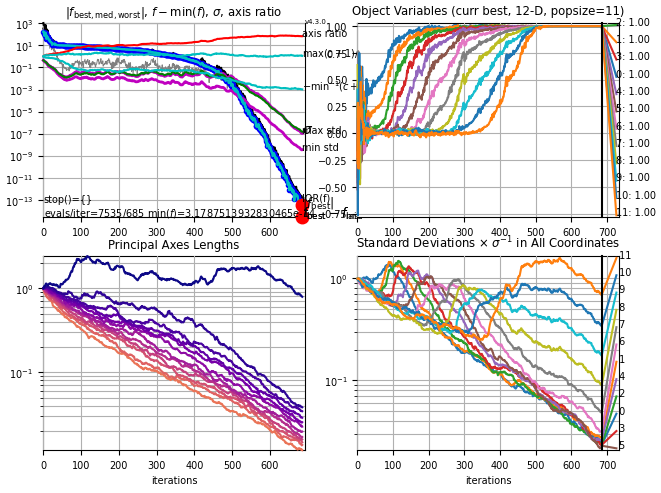
A single run on the 12-dimensional Rosenbrock function.
The CMAOptions class manages options for CMAEvolutionStrategy, e.g. verbosity options can be found like:
>>> import cma
>>> cma.s.pprint(cma.CMAOptions('erb'))
{'verb_log': '1  #v verbosity: write data to files every verb_log iteration, writing can be time critical on fast to evaluate functions'
 'verbose': '1  #v verbosity e.v. of initial/final message, -1 is very quiet, not yet implemented'
 'verb_plot': '0  #v in fmin(): plot() is called every verb_plot iteration'
 'verb_disp': '100  #v verbosity: display console output every verb_disp iteration'
 'verb_filenameprefix': 'outcmaes  # output filenames prefix'
 'verb_append': '0  # initial evaluation counter, if append, do not overwrite output files'
 'verb_time': 'True  #v output timings on console'}
Options are passed like:
>>> import cma
>>> es = cma.CMAEvolutionStrategy(8 * [0], 0.5,
                                  {'verb_disp': 1}) # display each iteration
Documentations
Read the full package documentation:
See also
General CMA-ES source code page with practical hints
Dependencies
required: numpy – array processing for numbers, strings, records, and objects
optional (highly recommended): matplotlib – Python plotting package (includes pylab)
Use pip install numpy etc. for installation. For a Python implementation of CMA-ES with lesser dependencies see here.
License: BSD
Release history Release notifications | RSS feed


Download files
Download the file for your platform. If you're not sure which to choose, learn more about installing packages.
Source Distribution
Built Distribution
Filter files by name, interpreter, ABI, and platform.
If you're not sure about the file name format, learn more about wheel file names.
Copy a direct link to the current filters
File details
Details for the file cma-3.0.3.tar.gz.
File metadata
- Download URL: cma-3.0.3.tar.gz
- Upload date:
- Size: 222.2 kB
- Tags: Source
- Uploaded using Trusted Publishing? No
- Uploaded via: twine/3.1.1 pkginfo/1.5.0.1 requests/2.21.0 setuptools/40.8.0 requests-toolbelt/0.9.1 tqdm/4.31.1 CPython/3.7.3
File hashes
| Algorithm | Hash digest | |
|---|---|---|
| SHA256 |
8f54d753fa2322d4fef1c40d899d65f0990a3b1b9b56ada0766c3cb9cb82bca8
|
|
| MD5 |
b9733c07ad9093197b11414ab6ead8f4
|
|
| BLAKE2b-256 |
f65e07995ae802cc1d13e1e68974361d5c177b64683571be8dd0860ab98528fd
|
File details
Details for the file cma-3.0.3-py2.py3-none-any.whl.
File metadata
- Download URL: cma-3.0.3-py2.py3-none-any.whl
- Upload date:
- Size: 230.3 kB
- Tags: Python 2, Python 3
- Uploaded using Trusted Publishing? No
- Uploaded via: twine/3.1.1 pkginfo/1.5.0.1 requests/2.21.0 setuptools/40.8.0 requests-toolbelt/0.9.1 tqdm/4.31.1 CPython/3.7.3
File hashes
| Algorithm | Hash digest | |
|---|---|---|
| SHA256 |
592d1a1973ee0d97b11958a00a33359f1dda9a7b56ca21b42b674665d0cca760
|
|
| MD5 |
542dcd59e369e431c15698be6dcbb5f4
|
|
| BLAKE2b-256 |
36c00a1c41f7cad0a51e07991cf86423d0e6651d035f1fe7dcff48e8858848f2
|






