
Command line tools for GitHub repo statistics

Project description
ghrepo-stats 
Have you ever wondered how the number of stargazers or the number of open issues has changed over time for your or any public GitHub repository? I did, so I wrote this small command line tool that will show this data.
ghrepo-stats uses pygithub to collect some statistics from a specific repository using a command line tool and show it using matplotlib or write it to a csv file.
Features
The following sub-commands are supported:
- stars: shows the number of stargazers over time (caveat: stargazers that have removed their star are not shown, as the info is not available)
- issues: shows the number of currently open issues over time
- prs: shows the number of currently open pull requests over time
- commits: shows the number of commits over the last year
- codesize: shows the change of the code size over time measured by the number of added and deleted lines
- issue-life: shows the average life time in days of issues over time (sampled once a week)
- pr-life: shows the average life time in days of issues over time (sampled once a week)
Caution: Using sub-commands related to issues and PRs on repositories with many (open or close) issues will take a lot of time due to API access limitations.
Installation
If you want to try it, you can install it from PyPi:
pip install ghrepo-stats
Or you can install the current main branch from GitHub:
pip install git+https://github.com/mrbean-bremen/ghrepo-stats
Usage
To use this, you need a GitHub account and a
personal access token
able to read public repositories for your GitHub account. The user name and
token is expected to be found in the file ghrepo-stats.ini, either in the
repository root, or in your home path.
The contents should be in the form:
[auth]
username = my-github-username
token = 123456789abcdef0123456789abcdef012345678
To get usage information you can now type:
$ show-ghstats -h
usage: show-ghstats [-h] [--verbose] [--csv CSV] sub_command repo_name

Shows GitHub repo statistics

positional arguments:
  sub_command    The kind of statistics to show. Possible values: 'issues',
                 'prs', 'stars', 'commits', 'codesize', 'issue-life', 'pr-
                 life'.
  repo_name      Full repository name in the form <repo_owner>/<repo_name>.

optional arguments:
  -h, --help     show this help message and exit
  --verbose, -v  Outputs diagnostic information
  --csv CSV      Write the output into a csv file with the given file path
So, for example, to get a star plot of a specific repository, you can write:
$ show-ghstats stars "my-github-username/my-repo"
If you want to have the numbers saved in a csv file instead to play around with the numbers you can write:
$ show-ghstats stars "my-github-username/my-repo" --csv=my_repo-issues
This will write a file my_repo-issues.csv with the numbers (date+time /
number of issues) in the current path.
Caching
Some of the values retrieved from repositories are cached - specifically
issues, prs, issue-life, pr-life and stars. The caches are written as json files
into the directory .ghrepo-stats in the home directory of the current user.
Especially for repositories with many issues this decreases the time needed to get
the data dramatically, if called a second time for the same repository.
Examples
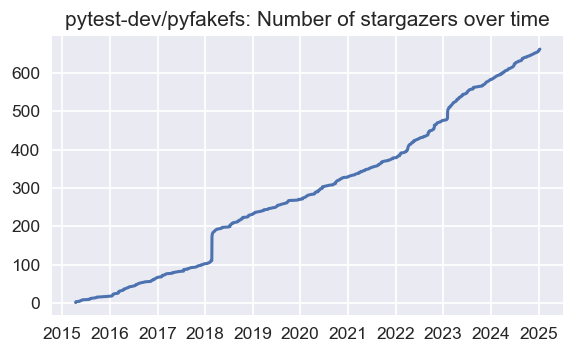
Get some measure of popularity change by showing the number of stargazers over time (note: stars that have been retracted are not counted):
$ show-ghstats stars "jmcgeheeiv/pyfakefs"
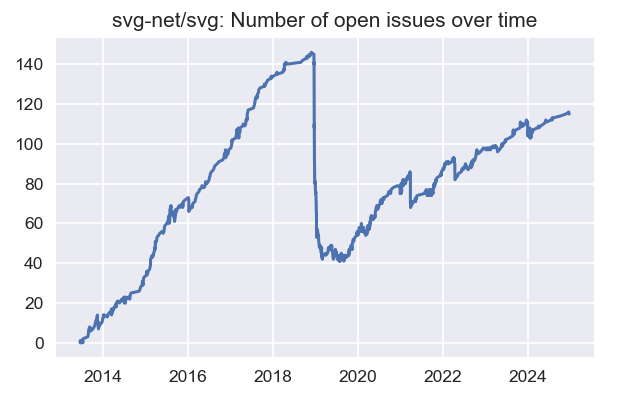
Check how issues are handled over time. There are two possibilities:
- Show the number of open issues at any point in time:
$ show-ghstats issues "vvvv/svg"
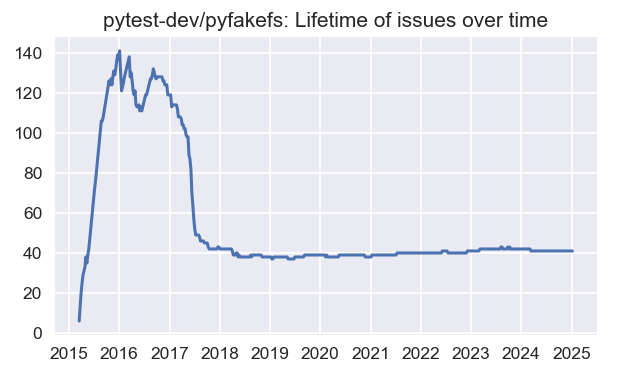
- Show the average lifetime of an issue as it changes over time. An increasing curve means ever more unresolved issues (also depends on the policies of the specific project - some projects leave issues open indefinitely, while others close outdated issues):
$ show-ghstats issue-life "jmcgeheeiv/pyfakefs"
Get some measure of activity by checking how the code size changed over time (measured in code additions/deletions):
$ show-ghstats codesize "pytest-dev/pytest"

Release history Release notifications | RSS feed


Download files
Download the file for your platform. If you're not sure which to choose, learn more about installing packages.
Source Distribution
Built Distribution
Filter files by name, interpreter, ABI, and platform.
If you're not sure about the file name format, learn more about wheel file names.
Copy a direct link to the current filters
File details
Details for the file ghrepo-stats-0.4.0.tar.gz.
File metadata
- Download URL: ghrepo-stats-0.4.0.tar.gz
- Upload date:
- Size: 8.5 kB
- Tags: Source
- Uploaded using Trusted Publishing? No
- Uploaded via: twine/4.0.1 CPython/3.10.1
File hashes
| Algorithm | Hash digest | |
|---|---|---|
| SHA256 |
8f39d877176499ddc7ef28ca3b1b9ac1233a80209f070651a3b318a4444a40db
|
|
| MD5 |
4a6f4551466294682cab9970f074ccef
|
|
| BLAKE2b-256 |
87954dc154f4961821582a7ad562d37cdcfa27990131a067d2c9397dd39a8694
|
File details
Details for the file ghrepo_stats-0.4.0-py3-none-any.whl.
File metadata
- Download URL: ghrepo_stats-0.4.0-py3-none-any.whl
- Upload date:
- Size: 8.5 kB
- Tags: Python 3
- Uploaded using Trusted Publishing? No
- Uploaded via: twine/4.0.1 CPython/3.10.1
File hashes
| Algorithm | Hash digest | |
|---|---|---|
| SHA256 |
47b5c692b078c5b3dda56bad08b89209b2f602550025ec6c17034bb08eef766b
|
|
| MD5 |
fcf4bd87d4a730fc07bd98af56735d5d
|
|
| BLAKE2b-256 |
d80093574563171d023212c46ce579733cad10a0993a315e02ddbef8c66d2cb7
|






