
Lazy dict

Project description







ldict
A lazy dict.
Latest release | Current code | API documentation
See also
- laziness+identity+persistence (idict)
Overview
A ldict is a dict with str keys.
Simple usage example
from ldict import ldict

a = ldict(x=3)
print(a)
"""
{
    "x": 3
}
"""
b = ldict(y=5)
print(b)
"""
{
    "y": 5
}
"""
print(a >> b)
"""
{
    "x": 3,
    "y": 5
}
"""
We consider that every value is generated by a process, starting from an empty ldict. The process is a sequence of
transformation steps done through the operator >>, which symbolizes a data flow. There are two types of steps:
- value insertion - represented by dict-like objects
- function application - represented by ordinary python functions
A ldict is completely defined by its key-value pairs so that
it can be converted from/to a built-in dict.
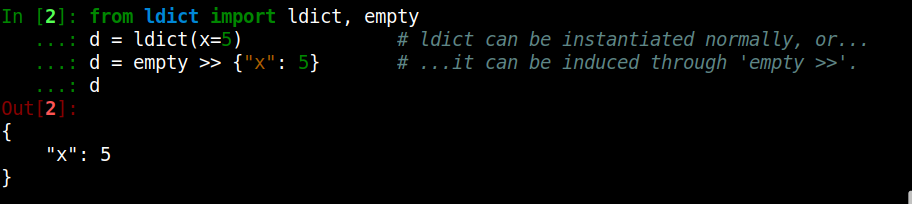
Creating a ldict is not different from creating an ordinary dict. Optionally it can be created through the >> operator
used after empty:
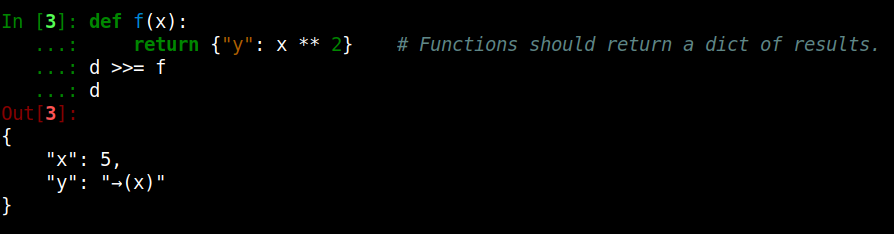
Function application is done in the same way. The parameter names define the input fields, while the keys in the
returned dict define the output fields:
Similarly, for anonymous functions:

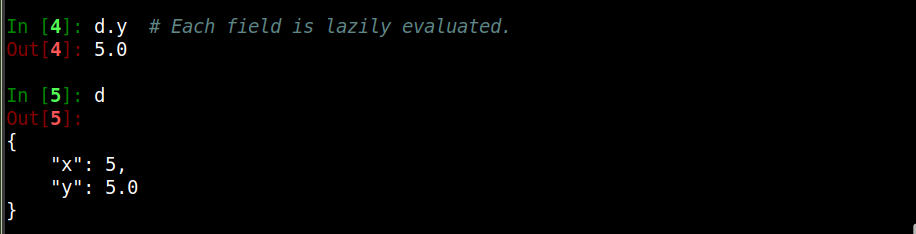
Finally, the result is only evaluated at request:
Installation
...as a standalone lib
# Set up a virtualenv.
python3 -m venv venv
source venv/bin/activate

# Install from PyPI...
pip install --upgrade pip
pip install -U ldict
pip install -U ldict[full]  # use this for extra functionality (recommended)

# ...or, install from updated source code.
pip install git+https://github.com/davips/ldict
...from source
git clone https://github.com/davips/ldict
cd ldict
poetry install
Examples
Merging two ldicts
from ldict import ldict

a = ldict(x=3)
print(a)
"""
{
    "x": 3
}
"""
b = ldict(y=5)
print(b)
"""
{
    "y": 5
}
"""
print(a >> b)
"""
{
    "x": 3,
    "y": 5
}
"""
Lazily applying functions to ldict
from ldict import ldict

a = ldict(x=3)
print(a)
"""
{
    "x": 3
}
"""
a = a >> ldict(y=5) >> {"z": 7} >> (lambda x, y, z: {"r": x ** y // z})
print(a)
"""
{
    "x": 3,
    "y": 5,
    "z": 7,
    "r": "→(x y z)"
}
"""
print(a.r)
"""
34
"""
print(a)
"""
{
    "x": 3,
    "y": 5,
    "z": 7,
    "r": 34
}
"""
Parameterized functions and sampling
from random import Random

from ldict import empty, let


# A function provide input fields and, optionally, parameters.
# For instance:
# 'a' is sampled from an arithmetic progression
# 'b' is sampled from a geometric progression
# Here, the syntax for default parameter values is borrowed with a new meaning.
def fun(x, y, a=[-100, -99, -98, ..., 100], b=[0.0001, 0.001, 0.01, ..., 100000000]):
    return {"z": a * x + b * y}


def simplefun(x, y):
    return {"z": x * y}


# Creating an empty ldict. Alternatively: d = ldict().
d = empty >> {}
print(d)
"""
{}
"""
# Putting some values. Alternatively: d = ldict(x=5, y=7).
d["x"] = 5
d["y"] = 7
print(d)
"""
{
    "x": 5,
    "y": 7
}
"""
# Parameter values are uniformly sampled.
d1 = d >> simplefun
print(d1)
print(d1.z)
"""
{
    "x": 5,
    "y": 7,
    "z": "→(x y)"
}
35
"""
d2 = d >> simplefun
print(d2)
print(d2.z)
"""
{
    "x": 5,
    "y": 7,
    "z": "→(x y)"
}
35
"""
# Parameter values can also be manually set.
e = d >> let(fun, a=5, b=10)
print(e.z)
"""
95
"""
# Not all parameters need to be set.
e = d >> let(simplefun, a=5)
print(e.z)
"""
35
"""
# Each run will be a different sample for the missing parameters.
e = e >> let(simplefun, a=5)
print(e.z)
"""
35
"""
# We can define the initial state of the random sampler.
# It will be in effect from its location place onwards in the expression.
e = d >> Random(0) >> let(fun, a=5)
print(e.z)
"""
725.0
"""
# All runs will yield the same result,
# if starting from the same random number generator seed.
e = e >> Random(0) >> let(fun, a=[555, 777])
print("Let 'a' be a list:", e.z)
"""
Let 'a' be a list: 700003885.0
"""
# Reproducible different runs are achievable by using a single random number generator.
e = e >> Random(0) >> let(fun, a=[5, 25, 125, ..., 10000])
print("Let 'a' be a geometric progression:", e.z)
"""
Let 'a' be a geometric progression: 700003125.0
"""
rnd = Random(0)
e = d >> rnd >> let(fun, a=5)
print(e.z)
e = d >> rnd >> let(fun, a=5)  # Alternative syntax.
print(e.z)
"""
725.0
700000025.0
"""
# Output fields can be defined dynamically through parameter values.
# Input fields can be defined dynamically through kwargs.
copy = lambda source=None, target=None, **kwargs: {target: kwargs[source]}
d = empty >> {"x": 5}
d >>= let(copy, source="x", target="y")
print(d)
d.evaluate()
print(d)

"""
{
    "x": 5,
    "y": "→(source target x)"
}
{
    "x": 5,
    "y": 5
}
"""
Composition of sets of functions
from random import Random

from ldict import empty


# A multistep process can be defined without applying its functions


def g(x, y, a=[1, 2, 3, ..., 10], b=[0.00001, 0.0001, 0.001, ..., 100000]):
    return {"z": a * x + b * y}


def h(z, c=[1, 2, 3]):
    return {"z": c * z}


# In the ldict framework 'data is function',
# so the alias ø represents the 'empty data object' and the 'reflexive function' at the same time.
# In other words: 'inserting nothing' has the same effect as 'doing nothing'.
fun = empty >> g >> h  # empty enable the cartesian product of the subsequent sets of functions within the expression.
print(fun)
"""
«λ{} × λ»
"""
# An unnapplied function has its free parameters unsampled.
# A compostition of functions results in an ordered set (Cartesian product of sets).
# It is a set because the parameter values of the functions are still undefined.
d = {"x": 5, "y": 7} >> (Random(0) >> fun)
print(d)
"""
{
    "x": 5,
    "y": 7,
    "z": "→(c z→(a b x y))"
}
"""
print(d.z)
"""
105.0
"""
d = {"x": 5, "y": 7} >> (Random(0) >> fun)
print(d.z)
"""
105.0
"""
# Reproducible different runs by passing a stateful random number generator.
rnd = Random(0)
e = d >> rnd >> fun
print(e.z)
"""
105.0
"""
e = d >> rnd >> fun
print(e.z)
"""
14050.0
"""
# Repeating the same results.
rnd = Random(0)
e = d >> rnd >> fun
print(e.z)
"""
105.0
"""
e = d >> rnd >> fun
print(e.z)
"""
14050.0
"""
Concept
A ldict is like a common Python dict, with extra functionality and lazy. It is a mapping between string keys, called fields, and any serializable (pickable protocol=5) object.
Grants
This work was partially supported by Fapesp under supervision of Prof. André C. P. L. F. de Carvalho at CEPID-CeMEAI (Grants 2013/07375-0 – 2019/01735-0).
Release history Release notifications | RSS feed


Download files
Download the file for your platform. If you're not sure which to choose, learn more about installing packages.
Source Distribution
Built Distribution
Filter files by name, interpreter, ABI, and platform.
If you're not sure about the file name format, learn more about wheel file names.
Copy a direct link to the current filters
File details
Details for the file ldict-3.211118.1.tar.gz.
File metadata
- Download URL: ldict-3.211118.1.tar.gz
- Upload date:
- Size: 16.9 kB
- Tags: Source
- Uploaded using Trusted Publishing? No
- Uploaded via: poetry/1.1.7 CPython/3.8.10 Linux/5.4.0-89-generic
File hashes
| Algorithm | Hash digest | |
|---|---|---|
| SHA256 |
f16c5c8804b6803c7a9c32fc31cec216055c76ee77d80c2d1eb10d3f29a3f027
|
|
| MD5 |
8122189833d37d2f4a352b51ebc71ad3
|
|
| BLAKE2b-256 |
9b4bd189a3fd99d6cd9322deb82896d128ab8cd7313cddb7d7af517df6067d53
|
File details
Details for the file ldict-3.211118.1-py3-none-any.whl.
File metadata
- Download URL: ldict-3.211118.1-py3-none-any.whl
- Upload date:
- Size: 24.7 kB
- Tags: Python 3
- Uploaded using Trusted Publishing? No
- Uploaded via: poetry/1.1.7 CPython/3.8.10 Linux/5.4.0-89-generic
File hashes
| Algorithm | Hash digest | |
|---|---|---|
| SHA256 |
8a197858df8b19f04a983578a31277254fefcb66c2b5c3c54f6a090f75847e9e
|
|
| MD5 |
34f1ce186a31e8dc4a6cec49247b14b9
|
|
| BLAKE2b-256 |
b2a95e8dd0549422ebeab85528c761cf86ed97915da37a850c87b8445a97499c
|






