
Framework for setting up predictive analytics services


Project description




Palladium
Palladium provides means to easily set up predictive analytics services as web services. It is a pluggable framework for developing real-world machine learning solutions. It provides generic implementations for things commonly needed in machine learning, such as dataset loading, model training with parameter search, a web service, and persistence capabilities, allowing you to concentrate on the core task of developing an accurate machine learning model. Having a well-tested core framework that is used for a number of different services can lead to a reduction of costs during development and maintenance due to harmonization of different services being based on the same code base and identical processes. Palladium has a web service overhead of a few milliseconds only, making it possible to set up services with low response times.
A configuration file lets you conveniently tie together existing components with components that you developed. As an example, if what you want to do is to develop a model where you load a dataset from a CSV file or an SQL database, and train an SVM classifier to predict one of the rows in the data given the others, and then find out about your model’s accuracy, then that’s what Palladium allows you to do without writing a single line of code. However, it is also possible to independently integrate own solutions.
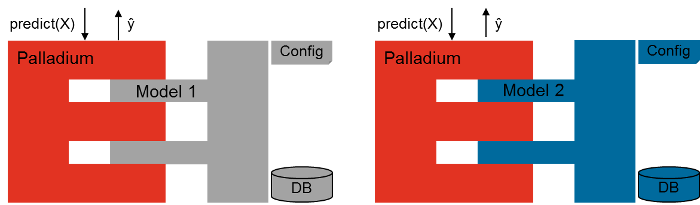
Much of Palladium’s functionality is based on the scikit-learn library. Thus, a lot of times you will find yourself looking at the documentation for scikit-learn when developing with Palladium. Although being implemented in Python, Palladium provides support for other languages and is shipped with examples how to integrate and expose R and Julia models.
For an efficient deployment of services based on Palladium, a script to create Docker images automatically is provided. In order to manage and monitor a number of Palladium service instances in a cluster, Mesosphere’s Mesos framework Marathon can be used for deployment, also enabling scalability by having a variable number of service nodes behind a load balancer. Examples how to create Palladium Docker images and how to use them with Mesos / Marathon are part of the documentation. Other important aspects – especially relevant in enterprise contexts for setting up productive services – like authentication, logging, or monitoring, can be easily integrated via pluggable decorator lists in the configuration file of a service, keeping track of service calls and corresponding permissions.
Everyone is welcome to contribute to Palladium. More information on how to to contribute can be found in the FAQ section of the Palladium documentation.
Links
Source code repository at GitHub: https://github.com/ottogroup/palladium
Documentation including installation instructions and tutorial: http://palladium.readthedocs.org
Mailing list: https://groups.google.com/forum/#!forum/pld-list
Maintainer: Andreas Lattner
Release history Release notifications | RSS feed


Download files
Download the file for your platform. If you're not sure which to choose, learn more about installing packages.
Source Distribution
Built Distribution
Filter files by name, interpreter, ABI, and platform.
If you're not sure about the file name format, learn more about wheel file names.
Copy a direct link to the current filters
File details
Details for the file palladium-1.0.1.tar.gz.
File metadata
- Download URL: palladium-1.0.1.tar.gz
- Upload date:
- Size: 38.3 kB
- Tags: Source
- Uploaded using Trusted Publishing? No
File hashes
| Algorithm | Hash digest | |
|---|---|---|
| SHA256 |
60af50714883a0adaa48bba260c529eca5412709c538eb3690ad36a0bfae5218
|
|
| MD5 |
0879508af936b607cb55a82a544ba27a
|
|
| BLAKE2b-256 |
beac58f28f96e592808a7702083fe683976acc507c851906cb759dd4133dedbe
|
File details
Details for the file palladium-1.0.1-py3-none-any.whl.
File metadata
- Download URL: palladium-1.0.1-py3-none-any.whl
- Upload date:
- Size: 49.8 kB
- Tags: Python 3
- Uploaded using Trusted Publishing? No
File hashes
| Algorithm | Hash digest | |
|---|---|---|
| SHA256 |
f146bb3bd700408be826d4b56696205495fe88e05de1890cd85eba4142a37db2
|
|
| MD5 |
8922279d6b92d9ca7a4ea62fa0e7bb11
|
|
| BLAKE2b-256 |
8ce7f3c553e72aa0951a2c207ddc5d155b3c3abcf59aeabadbdbfc8af5f16f82
|






