pyinfra automates/provisions/manages/deploys infrastructure.

Project description

pyinfra automates infrastructure super fast at massive scale






Documentation • Getting Started • Examples • Help & Support • Contributing
pyinfra automates/provisions/manages/deploys infrastructure. It can be used for ad-hoc command execution, service deployment, configuration management and more. Design features include:
- 🚀 Super fast execution over thousands of hosts with predictable performance.
- 🚨 Instant debugging with stdout & stderr output on error or as required (
-v|-vv|-vvv). - 📦 Extendable with any Python package as configured & written in standard Python.
- 💻 Agentless execution against SSH/Docker/subprocess/winrm hosts.
- ❗️ Two stage process that enables
--dryruns before executing any changes. - 🔌 Integrated with Docker, Vagrant/Mech & Ansible out of the box.
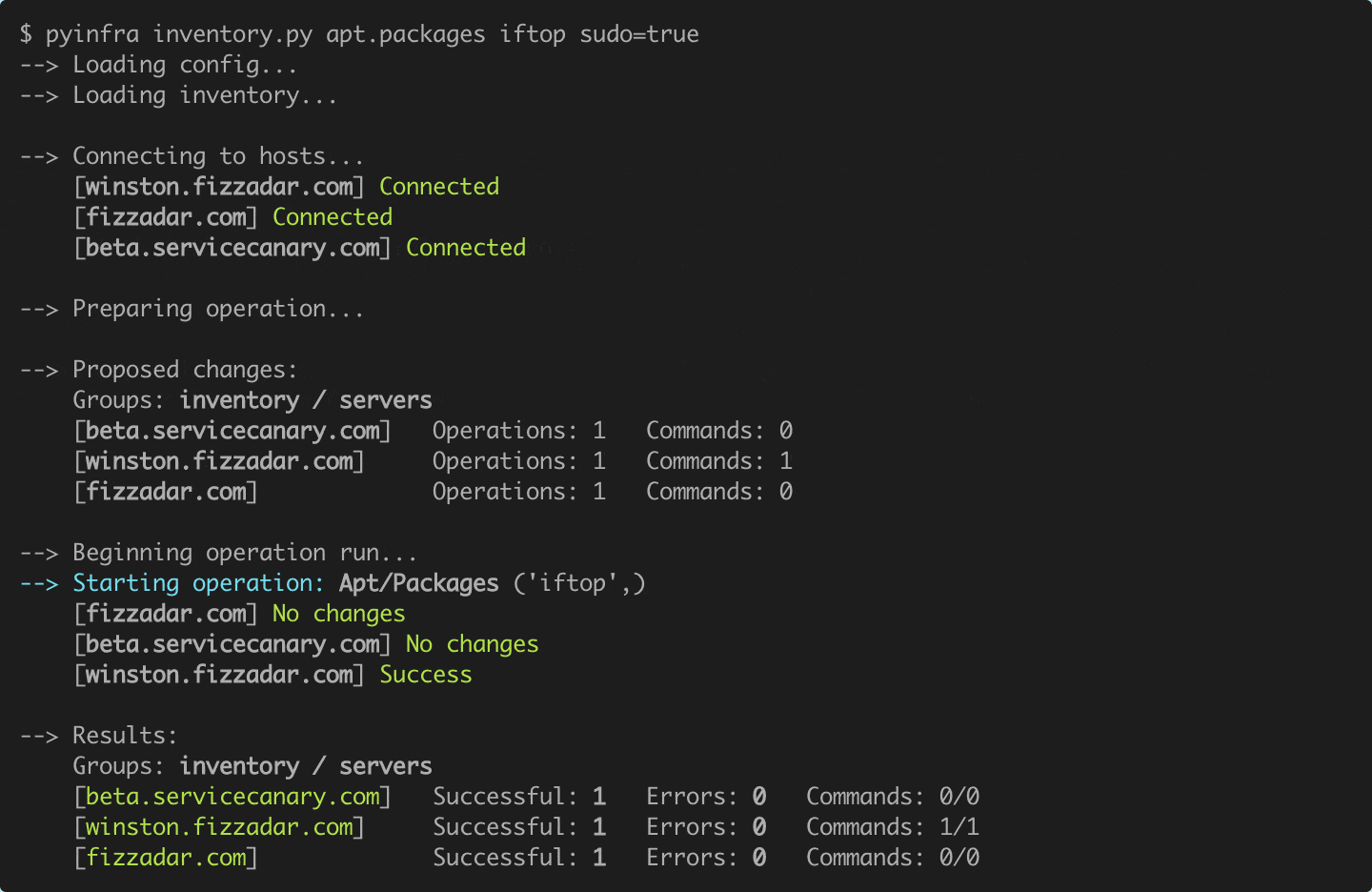
When you run pyinfra you'll see something like (non animated version):

Quickstart
Install pyinfra with pipx (recommended) or pip:
pipx install pyinfra
Now you can execute commands on hosts via SSH:
pyinfra my-server.net exec -- echo "hello world"
Or execute in Docker, on the local machine, and other connectors:
pyinfra @docker/ubuntu exec -- echo "Hello world"
pyinfra @local exec -- echo "Hello world"
As well as executing commands you can define state using operations:
# Install iftop apt package if not present
pyinfra @docker/ubuntu apt.packages iftop update=true _sudo=true
Which can then be saved as a Python file like deploy.py:
from pyinfra.operations import apt

apt.packages(
    name="Ensure iftop is installed",
    packages=['iftop'],
    update=True,
    _sudo=True,
)
The hosts can also be saved in a file, for example inventory.py:
targets = ["@docker/ubuntu", "my-test-server.net"]
And executed together:
pyinfra inventory.py deploy.py
Now you know the building blocks of pyinfra! By combining inventory, operations and Python code you can deploy anything.
See the more detailed getting started or using operations guides. See how to use inventory & data, global arguments and the CLI or check out the documented examples.
Release history Release notifications | RSS feed


Download files
Download the file for your platform. If you're not sure which to choose, learn more about installing packages.
Source Distribution
Built Distribution
Filter files by name, interpreter, ABI, and platform.
If you're not sure about the file name format, learn more about wheel file names.
Copy a direct link to the current filters
File details
Details for the file pyinfra-2.0.1.tar.gz.
File metadata
- Download URL: pyinfra-2.0.1.tar.gz
- Upload date:
- Size: 174.9 kB
- Tags: Source
- Uploaded using Trusted Publishing? No
- Uploaded via: twine/4.0.0 CPython/3.9.4
File hashes
| Algorithm | Hash digest | |
|---|---|---|
| SHA256 |
d79ecdb6903ce454b6ecb9f55ecbeae7faae992b2bd164833a11b45303149d11
|
|
| MD5 |
9a132bb0e2f473d6806283e7259c4245
|
|
| BLAKE2b-256 |
6d5f5cb04fbc183acac2c44c942203c78cd4b0fa2cafa7ddb0aa2d814493d746
|
File details
Details for the file pyinfra-2.0.1-py2.py3-none-any.whl.
File metadata
- Download URL: pyinfra-2.0.1-py2.py3-none-any.whl
- Upload date:
- Size: 227.3 kB
- Tags: Python 2, Python 3
- Uploaded using Trusted Publishing? No
- Uploaded via: twine/4.0.0 CPython/3.9.4
File hashes
| Algorithm | Hash digest | |
|---|---|---|
| SHA256 |
8a65774c4e69340791944ccf1dbabb188d765dbd6102058427a3770e4444e3ab
|
|
| MD5 |
49dd4c627287e4a98795b2d0a911029e
|
|
| BLAKE2b-256 |
2efc13f598493e3ad70302c905b8c45633f6f71958df72c8aced5bf4fb8bddd2
|